Comparing Accelerated College Pathways Completion Rates with Traditional 4-Year Degrees
Anúncios
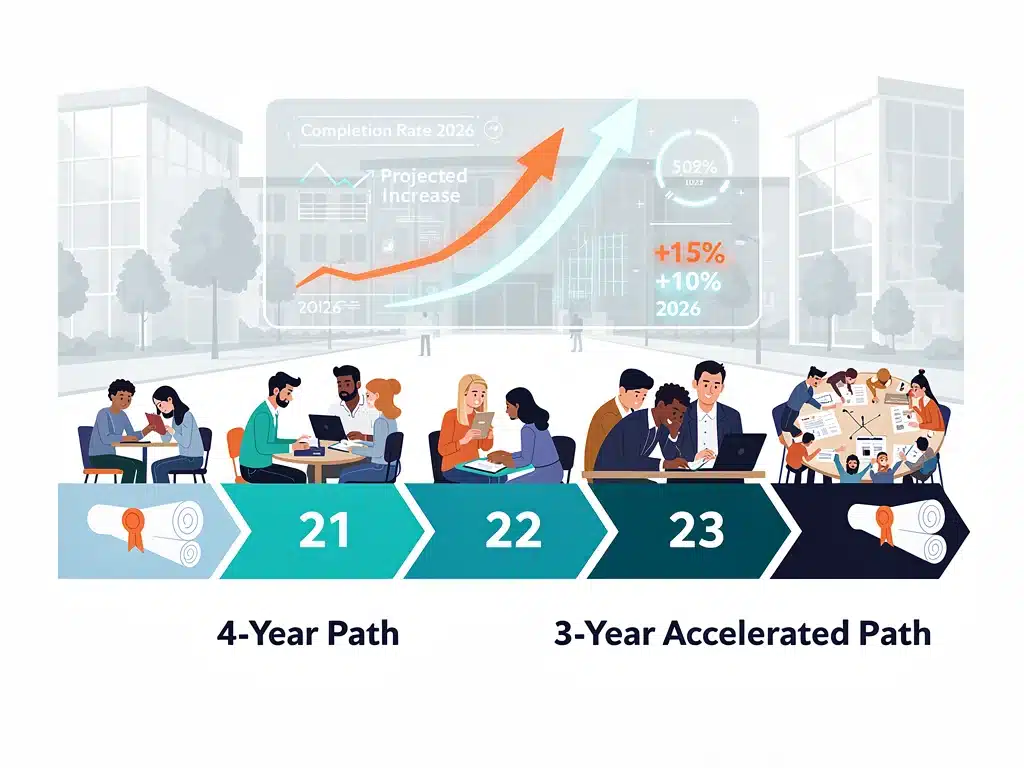
As skyrocketing tuition and debt force students to question the value of higher education, traditional higher ed models are facing a reckoning. Driven by this urgency, rising interest in accelerated college pathways completion is shifting focus toward 3-year bachelor’s tracks as a practical alternative to standard timelines.
Fast-tracked degree models promise to slash tuition costs and fast-forward entry into the workforce. By compressing standard coursework through condensed schedules and maximized transfer credits, these intensive formats aim to boost persistence and curb dropout rates.
However, shortening the academic journey raises essential questions about retention, student burnout, and long-term educational outcomes. Let’s break down how 3-year programs stack up against standard 4-year tracks and what the latest completion data reveals.
The Rise of Accelerated College Pathways
The concept of accelerated college pathways has gained considerable momentum over the past decade, driven by a desire to reduce student debt and enter the workforce sooner.
These programs often condense the traditional four-year curriculum into three years, requiring students to take heavier course loads or attend summer sessions.
Universities are increasingly exploring and implementing these programs as a strategic response to changing demographics and economic realities.
Anúncios
The appeal lies in offering a more efficient route to a degree, potentially making higher education more accessible and affordable for a broader range of students.
However, the efficacy of accelerated models in maintaining completion rates comparable to or higher than traditional four-year programs remains a key area of investigation. By 2026, a clearer picture of their long-term success and sustainability is expected to emerge.
Comparing Completion Rates: 4-Year vs. 3-Year Tracks
Historically, the standard four-year degree track has been the benchmark for undergraduate education, with established completion rate metrics.
These rates, while varying significantly by institution and student demographic, provide a baseline against which accelerated programs are now being measured.
The challenge for three-year degree programs is to demonstrate that their compressed timeline does not compromise academic rigor or student success, particularly in terms of graduation.
Early data suggests mixed results, with some institutions reporting strong outcomes while others face hurdles in student retention.
As 2026 approaches, researchers are closely monitoring how these two distinct pathways perform in terms of student persistence and ultimate degree attainment. The focus is not just on raw numbers but also on the quality of the educational experience and postgraduate success.
Factors Influencing Accelerated College Pathways Completion
Several critical factors influence the completion rates in both standard and accelerated programs. Student preparedness, financial support, institutional resources, and the quality of academic advising play significant roles in a student’s ability to navigate their chosen pathway successfully.
For accelerated programs, the intensity of the curriculum and the potential for burnout are additional considerations that can impact completion. Institutions must implement robust support systems to help students manage the increased academic load and maintain their well-being.
- Student financial aid and scholarship availability are crucial for sustained enrollment.
- Effective academic advising and mentorship programs enhance student persistence.
- Institutional support services, including mental health and career counseling, are vital.
- Curriculum design must balance rigor with feasibility for accelerated timelines.
The Student Perspective: Benefits and Challenges
From a student’s viewpoint, the primary benefit of an accelerated program is the potential for reduced tuition costs and an earlier entry into the job market.
This can translate into significant financial advantages, especially for those from lower-income backgrounds or those eager to begin their careers.
Anúncios
However, the challenges are equally substantial. The condensed timeline often means less time for internships, extracurricular activities, and personal growth experiences that are integral to the traditional college experience. Students must weigh these trade-offs carefully.
The pressure to perform academically in a shorter timeframe can also be immense, potentially affecting mental health and overall satisfaction. Understanding these student experiences is vital for institutions designing and promoting accelerated college pathways completion.

Navigating Academic Rigor in Accelerated Programs
Accelerated programs demand a high level of self-discipline and academic commitment. Students must be prepared for intensive coursework and a fast-paced learning environment from day one. This requires strong foundational skills and a clear understanding of their academic goals.
Institutions offering these programs often implement stringent admission criteria to ensure that students are adequately prepared for the demanding curriculum. This selectivity aims to mitigate potential drops in completion rates due to academic unpreparedness.
- Strong time management skills are essential for success in accelerated tracks.
- Proactive engagement with faculty and academic resources is highly beneficial.
- Prior academic performance and motivation are key indicators of success.
- Flexibility and adaptability are crucial for managing the intense workload.
Institutional Strategies for Boosting Completion Rates
Universities are actively developing strategies to enhance completion rates across all pathways, including accelerated college pathways completion.
These strategies ranging from targeted academic support to innovative pedagogical approaches designed to keep students engaged and on track.
Investing in early warning systems that identify struggling students allows for timely interventions, such as tutoring, counseling, or academic coaching.
These proactive measures are particularly important in accelerated programs where students have less time to recover from academic setbacks.
Furthermore, institutions are exploring flexible course delivery models, including hybrid and online options, to accommodate diverse student needs and schedules. These innovations aim to reduce barriers to completion and support a wider array of learning styles.
The Economic Impact of Degree Pathways
The economic implications of college completion are far-reaching, affecting individual students, institutions, and the broader economy. Higher completion rates generally correlate with a more skilled workforce, increased tax revenues, and reduced reliance on social welfare programs.
For students, completing a degree, whether through a 4-year or 3-year track, significantly improves earning potential and career prospects. The reduced time-to-degree in accelerated programs can mean earlier entry into higher-paying jobs, yielding a quicker return on investment in education.
Institutions benefit from higher completion rates through enhanced reputation, increased alumni engagement, and improved funding opportunities. The efficiency of accelerated college pathways completion can also optimize resource allocation within universities.

Workforce Readiness and Accelerated Degrees
A key argument for accelerated degrees is their potential to quickly equip graduates with in-demand skills for the workforce. Industries are constantly evolving, and a shorter time to degree can mean that graduates enter the job market with more current knowledge and competencies.
However, concerns exist that accelerated programs might not provide sufficient time for students to develop essential soft skills, gain practical experience through internships, or build professional networks. These elements are often crucial for long-term career success.
To address this, many accelerated programs are integrating experiential learning opportunities and career development resources directly into their condensed curricula.
The goal is to ensure that graduates are not only academically proficient but also fully prepared for the demands of their chosen professions.
Projected Trends for 2026 and Beyond
By 2026, it is anticipated that data will show a clearer differentiation in completion rates between standard and accelerated pathways. Early indicators suggest that well-supported accelerated programs, particularly in fields with high demand, could see competitive completion rates.
The adoption of hybrid learning models and personalized academic plans is expected to play a significant role in improving completion rates across the board. These innovations offer flexibility and tailored support that can help a wider range of students succeed.
Furthermore, increased collaboration between higher education institutions and industry partners will likely shape future curriculum development, ensuring that degree programs, both 4-year and 3-year, remain relevant and effective in preparing students for the evolving job market.
Policy and Funding Implications for Accelerated Programs
Government policies and funding mechanisms significantly impact the viability and expansion of accelerated degree programs. Policy decisions regarding financial aid eligibility for these compressed timelines are crucial for student access and affordability.
Currently, many federal and state financial aid programs are structured around the traditional four-year model, posing challenges for students in three-year programs. Adjustments to these policies are necessary to ensure equitable support for all students pursuing higher education.
Funding for innovative program development and institutional support services will also be vital for the continued growth and success of accelerated college pathways completion initiatives. This includes investments in technology, faculty training, and student support infrastructure.
| Key Point | Brief Description |
|---|---|
| Completion Rate Variance | Expected differentiation in completion rates between 4-year and 3-year programs by 2026. |
| Student Support Criticality | Robust academic and emotional support systems are essential for accelerated success. |
| Economic & Workforce Impact | Accelerated degrees can reduce debt and accelerate workforce entry, influencing economic growth. |
| Policy & Funding | Adaptation of financial aid and policy frameworks is needed to support 3-year programs effectively. |
Frequently Asked Questions About College Pathways
An accelerated college pathway typically condenses a traditional four-year bachelor’s degree into three years. This often involves taking more credits per semester, attending summer sessions, or a combination of both. The goal is to reduce time to degree and overall educational costs, while maintaining academic rigor and learning outcomes.
Generally, yes. As long as the three-year degree is from an accredited institution and meets the necessary academic standards, it is recognized similarly to a four-year degree. The key is the accreditation and the quality of the education received, not solely the duration of the program.
Students in accelerated programs face increased academic pressure due to heavier course loads and shorter timelines. Challenges include managing time effectively, potential for burnout, limited opportunities for extracurriculars or internships, and the need for strong self-discipline. Robust support systems are crucial for success.
Accelerated programs can significantly reduce student debt by cutting down on one year’s worth of tuition, fees, and living expenses. This financial benefit is a major draw for many students and families, making higher education more affordable and accessible in the long run.
Institutions play a critical role by providing comprehensive academic and personal support, effective advising, and flexible learning options. They also design rigorous yet manageable curricula and foster an environment that encourages student persistence, all of which contribute to higher completion rates for all students.
Looking Ahead
The ongoing evaluation of accelerated college pathways completion represents a vital development in higher education. As 2026 approaches, the emerging data will clarify the efficacy of these programs and guide future institutional and policy decisions.
This shift underscores a broader trend towards more flexible and cost-effective educational models, aiming to meet the diverse needs of students and the evolving demands of the global workforce.